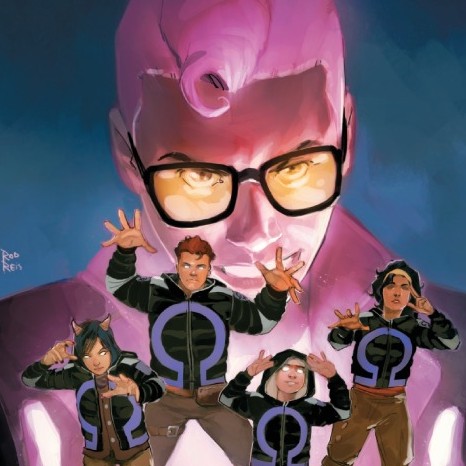
 In Omega Kids #1, the once-revolutionary Quentin Quire becomes the very thing he feared for most of his life: the establishment.
Part of the Age of Revelation event, Omega Kids #1 takes us X years into Revelation’s mutant nation. Quentin Quire —formerly Kid Omega— has been deputized as an enforcer of the cause, silencing anyone who opposes his leader’s rule. The silencing is figurative and literal; those who try to resist are turned into speechless “Babels” who cannot communicate at all. With his squad of “Omega Kids,” all adolescent telepaths with the potential for greatness, he is working to ensure Revelation’s will is obeyed for years to come. But little does he know, his proteges may not be completely on the same page as him…
At its core, Omega Kids seems to be about generational discrepancies and the changing of the guard from one ideology to the next. As a younger-but-still-aging millennial, this theme is very relevant to me right now. (We all know that one Simpsons clip about it.) Although he was considered a revolutionary for his time, we find an older Quentin Quire now firmly part of the establishment, enforcing ideals he may have found ideologically offensive or wrong in his youth. To him, Revelation’s world is the one he always fought for, so why should it change back? That’s a classic conundrum people experience as they age. Used to be too progressive, but now seen as either content to maintain the status quo or even regressive.
It’s an interesting question to raise, even if it’s not especially novel or unique within the history of X-Men storylines at this point. It does seem like some variation on this theme happens every other year or so, which is sort of the defining problem of this era of X-Men; Krakoa was so new that everything that’s come since then feels outdated or not as exciting. This is, incidentally, also sort of baked into the narrative of Omega Kids. How appropriate.
At the very least, the creative team of Omega Kids is pretty solid. I have to assume writer Tony Fleecs is a massive Quentin fan, because generally speaking people either love him or hate him. But he does portray the guy here as perfect or completely morally sound, which offers dimensionality and a character arc for him to embark on throughout the series. I’m also interested in the new kids, but as with every “new class” of X-Men, let’s not hold our breath about their long-term prospects, especially since this is a possible future. Andrés Genolet’s art is very appealing (made even more so by Fer Sifuentes-Sujo’s colors) and fits in perfectly with the visual aesthetic of this X-era. If you’re a fan of the character or the themes presented despite your interest in the overarching event, there’s probably enough in Omega Kids #1 to keep you hooked.
Omega Kids #1
3.99
Credits
- Writer: Tony Fleecs
- Artist: Andrés Genolet
- Color Artist: Fer Sifuentes-Genolet
- Letterer: VC's Travis Lanham
- Cover Artist: Rod Reis
Credits (cont)
- Editor: Darren Shan
- Publisher: Marvel Comics